
Wondering whether your mare is carrying a colt or filly?
We’re launching a foetal gender determination scanning clinic at Barton Hill, allowing owners and breeders to discover their foal’s sex before birth.
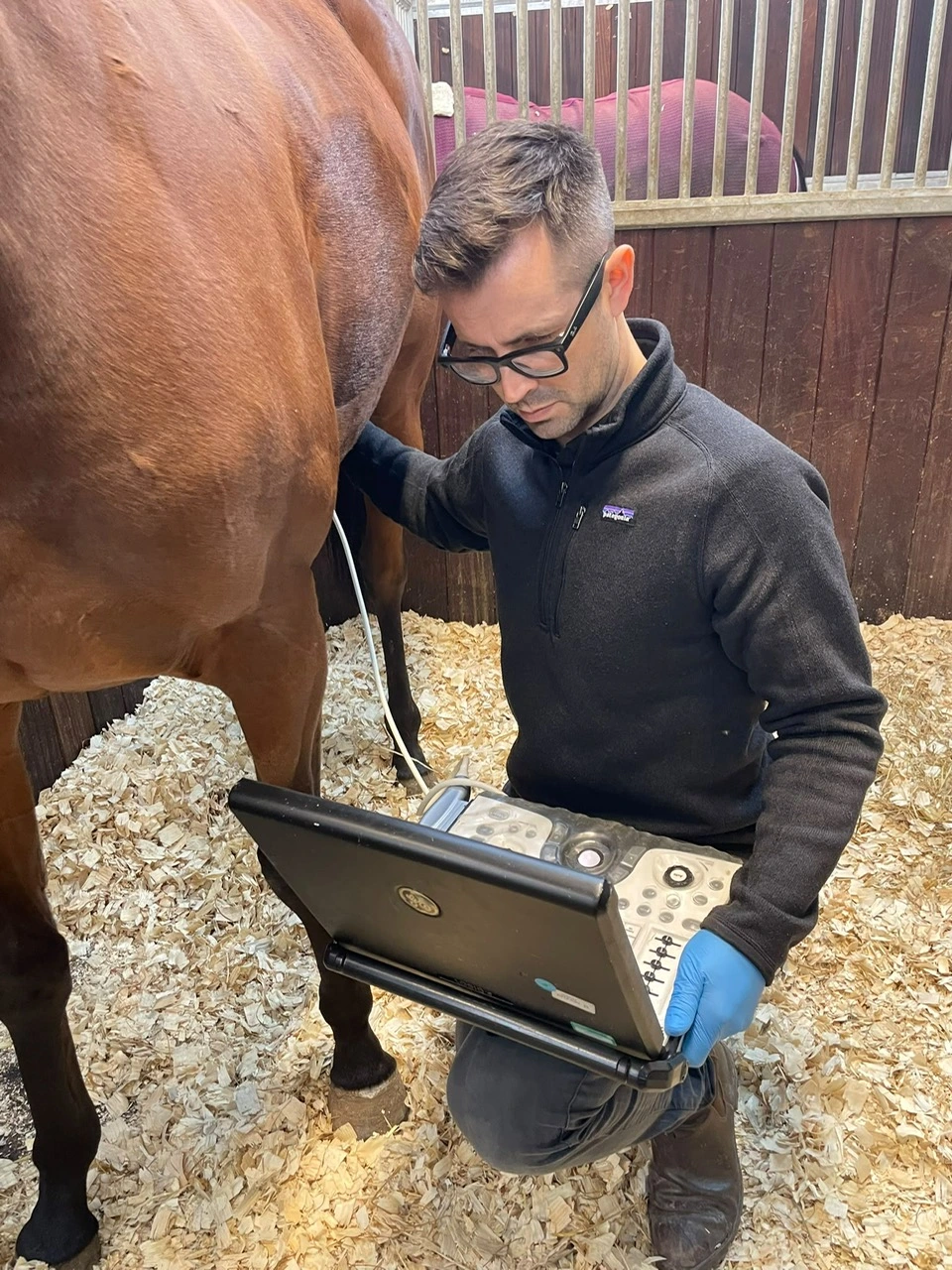
Led by Rory and Phoebe, our service uses transabdominal ultrasound to determine whether a mare is carrying a colt or filly.
Unlike traditional transrectal scanning, which involves introducing an ultrasound probe into the mare’s rectum, transabdominal ultrasound allows our team to examine the developing foal externally through the mare’s abdominal wall.
This approach is a non-invasive way to determine your foal’s sex.
We’re offering this specialist scanning clinic to give both existing clients and new visitors the opportunity to find out more about their unborn foal.
Why find out whether you're expecting a colt or a filly?
There are both practical and emotional benefits to discovering the sex of your foal before birth.
For breeders with specific long-term breeding goals, knowing whether to expect a colt or filly can help inform future planning and decisions.
There’s also something special about learning another detail about the foal you’ve been waiting months to meet.
1. Planning for the future of your bloodlines
Breeding plans can take years of consideration. Breeders have to carefully consider a mare’s bloodlines, the stallion to reproduce with and the qualities they hope to pass on to future generations.
Knowing whether the foal is a colt or filly can help breeders plan ahead.
A foal’s sex alone doesn’t determine its breeding potential or ability. However, finding out before birth gives breeders more time to think about their options, including whether to keep the foal, sell it or consider its place in their longer-term breeding plans.
2. Understanding the opportunities for Thoroughbred breeders
In the Thoroughbred industry, a foal’s sex can be an important consideration when assessing its potential commercial and breeding future.
A colt with the right pedigree and subsequent racing performance has the potential to progress to a career as a stallion.
A filly also offers opportunities on the racecourse, though the possibility of contributing to future generations as a broodmare is less contingent upon success as long as the pedigree is desirable.
For breeders investing considerable time and resources into their bloodlines, knowing whether they’re expecting a colt or filly can help inform early discussions about future ownership, management and sales plans.
3. Sharing in the anticipation of discovering your foal’s sex
Not every owner is breeding for the sales ring or planning a future broodmare band.
Perhaps you’ve already started thinking about names or you’re simply too impatient to wait. Finding out the sex won’t tell you what sort of temperament the foal will have, how it will move or what it might achieve. But, much like finding out the sex of a baby, it can make the months of waiting feel more real and give you another detail to look forward to before foaling day.
How does transabdominal foal sexing work?
Our service uses transabdominal ultrasound to externally examine the developing foal through the mare’s abdomen.
The process is similar to an external pregnancy scan in humans.
Your mare will usually remain standing while we gently move a handheld ultrasound probe across the underside of her abdomen.
Clipping an area of hair is usually unnecessary. Then alcohol is applied to the skin to optimise contact with the probe to produce clear images. Sedation is rarely needed.
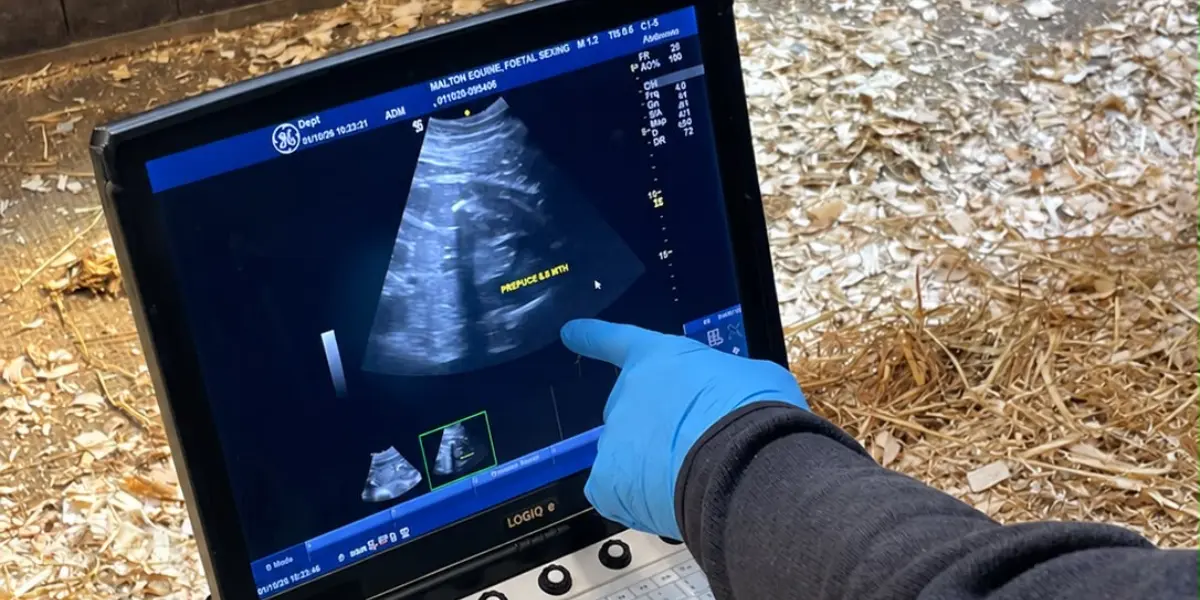
The scanner sends high-frequency sound waves into the abdomen and uses the returning echoes to create real-time images of the foal on a screen.
When examining the images we’ll look for anatomical structures, including the developing reproductive organs, that help determine the foal’s sex.
A non-invasive alternative to transrectal scanning
With transabdominal ultrasound, the probe is placed against the mare’s abdomen rather than being inserted into the rectum. This provides a non-invasive alternative to transrectal scanning.
The technique is particularly useful for foetal sex determination between approximately 120 and 210 days of pregnancy, when the foal’s reproductive structures are more developed and can be examined more directly.
What does the scan look for?
For foetal sex determination, we focus on the foal’s lower abdomen and hindquarters, where the developing reproductive anatomy can be examined.
This involves locating the foal, establishing its orientation and obtaining a suitable view of the relevant structures.
In a male foetus, the penis and prepuce may be identified between the hind legs whereas in a female, the mammary gland (udder) and teats are imaged in this anatomical region.
We also look for variations in length and location of the urethra.
Male and female gonads are located in the same portion of the abdomen during this gestational window, however, there are subtle differences that allow us to tell whether they are developing into testicles or ovaries.
Why timing, position and experience matter
The process requires a detailed understanding of equine foetal anatomy, specialist ultrasound knowledge and experience interpreting the images.
It isn’t simply a case of spotting one feature and making a judgement. The visible structures need to be assessed together to establish whether the findings support a confident determination.
The clarity of ultrasound images depends on several factors, including the stage of pregnancy and the foal’s position, as well as the ultrasound scanner itself.
Foals move within the uterus, and their limbs or bones can temporarily obscure the areas that need to be examined. Sometimes, obtaining a clear view requires careful adjustment of the ultrasound probe and patience while the foal changes position.
Our equine ultrasounds will be conducted by Rory and Phoebe, whose specialist qualifications include a Certificate of Advanced Clinical Practice in Equine Stud Medicine. They are both Diplomates of the American College of Theriogenologists and are recognised RCVS Specialists in Equine Reproduction.
Their expertise in equine reproduction and reproductive imaging provides the specialist knowledge needed to assess the developing foal’s anatomy and interpret the findings carefully.
The knowledge behind our foal sexing service
“We’ve wanted to offer this clinic because I think it gives breeders and horse owners a valuable opportunity to find out more about their unborn foal.
“Foetal sex determination is a fascinating area of equine reproduction, but most breeders don’t seek out the service, perhaps because they don’t understand how routine and non-invasive the procedure can be or perhaps based on presumed cost. These clinics will help change that perception.
“We’ve worked hard to develop our knowledge and expertise in equine reproduction, and we’re proud that Malton Equine can offer this specialist service. It’s a great opportunity to put those skills into practice and provide something different for our clients, as well as welcoming owners who may not have used the practice before.
“And of course, there’s a magic to the big unveil at the heart of it all.” — Rory Gormley, RCVS Specialist in Equine Reproduction.

What does the research tell us about accuracy?
Foetal sex determination is an established veterinary technique, and published research has demonstrated encouraging results when the relevant anatomical structures can be visualised clearly.
In a study published in 2018, researchers examined 121 mares. Of the 118 examinations where a diagnosis could be made, 116 were correct. That’s a very accurate score of approximately 98%.
Both incorrect diagnoses occurred when only one anatomical feature was visible and was misinterpreted. This highlights the importance of assessing all visible structures together before reaching a conclusion and being prepared on the very odd occasion to look again later, once the foal has moved.
Get in touch to find out more about your unborn foal
Waiting for a foal is a special experience, full of possibilities and anticipation.
Discovering its sex won’t tell you everything about the horse it will become, but it can help give the foal an identity while you plan for its future and make the months before birth feel even more compelling.
If you have a pregnant mare and would like to find out more about our new equine sex determination scanning at Barton Hill, contact our team today.
We can discuss your mare’s stage of pregnancy and whether the timing is right for a scan. You do not need to be a registered client to use this clinic.